

Dinosaur Facts
Updated: February 26, 2026
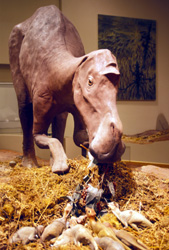
Montana has incredible stories to tell—especially from the time when dinosaurs roamed the Earth. Just as Big Sky Country is a great habitat for wildlife today, millions of years ago, Montana was prime territory for dinosaurs like Maiasaura, Brachylophosaurus, Triceratops, and many more.
Montana is one of the world’s top paleontology hotspots. The first Tyrannosaurus rex skeleton ever discovered was found here in 1902 by Barnum Brown. Montana also yielded North America’s first baby dinosaur bones and the famous Egg Mountain nesting site, which changed how scientists think about dinosaur parenting. The state boasts some of the best-preserved dinosaur specimens in the world, including the Guinness World Record holder “Leonardo,” a mummified Brachylophosaurus.
HADROSAURIDS (Duck-billed Dinosaurs)
-
MAIASAURA
- Name means “good mother lizard” in Greek.
- Montana’s state fossil.
- Lived about 76–74 million years ago in the Late Cretaceous.
- Famous for nesting colonies and caring for young—discovered at Egg Mountain in the Two Medicine Formation near Choteau.
- Jack Horner’s team found 15 hatchlings, each about 14 inches long and 1.5 pounds, in bowl-shaped nests about 7 feet wide.
- First unhatched dinosaur embryo in the U.S. was found here.
- Adults were about 30 feet long, weighed 3 tons, and had a duckbill-shaped snout.
-
BRACHYLOPHOSAURUS
- Name means “short-crested lizard.”
- Plant-eating hadrosaur, lived about 77 million years ago.
- Famous specimens:
“Elvis” (1994) – one of the most complete skeletons found in Montana.
“Leonardo” (2000) – a mummified Brachylophosaurus, recognized by Guinness World Records as the best-preserved dinosaur ever found.
-
LAMBEOSAUR
- A type of hadrosaur with a bony crest on its skull.
- Named after Canadian paleontologist Lawrence Lambe.
- Lived during the Late Cretaceous (about 76–75 million years ago).
- Known as the “cows of the Cretaceous” because they were abundant plant-eaters.
- Fossil nests show clutches of up to 22 eggs, some with embryos.
-
GRYPOSAURUS
- Name means "hook-nosed lizard."
- Lived 83–75 million years ago in Montana’s Two Medicine Formation.
- About 30 feet long, traveled in herds, and cared for young.
- Had hundreds of teeth that were replaced throughout its life.
-
ANATOTITAN COPEI
- Name means "giant duck."
- Over 30 feet long, weighed about 3.5 tons.
- Fossil found near Ekalaka in 1938; specimen displayed at Carter County Museum.
ORNITHOMIMIDS
-
STRUTHIOMIMUS
- Name means "ostrich mimic.
- About 11.5 feet long, weighed 220 pounds.
- Toothless omnivore; swallowed food whole and used gastroliths (stomach stones) to grind food.
- Built for speed with long legs and a stiff tail for balance.
PACHYCEPHALOSAURIDS STYGIMOLOCH
- Name means “demon from the river Styx.”
- Known for its thick, domed skull and spikes.
- Fossil skull found near Jordan, Montana, in 2003.
TYRANNOSAURIDS
-
TYRANNOSAURUS REX
- Name means “tyrant lizard king.”
- Largest carnivorous dinosaur in North America.
- About 40 feet long, weighed 6–7.5 tons.
- Had 60 teeth and the strongest bite force of any land animal.
- Arms were only 3 feet long with two fingers.
- Famous Montana specimens:
“Peck’s Rex” at Fort Peck Field Station.
“B-rex” femur revealed soft tissue and proteins in 2005.
-
GORGOSAURUS
- Name means “gorgon lizard.”
- Close relative of T. rex; about 26–30 feet long.
- More than 20 skeletons discovered, making it one of the best-known tyrannosaurids.
-
ALBERTOSAURUS
- Name means “Alberta lizard.”
- Lived about 75 million years ago.
- Smaller than T. rex but still a formidable predator.
-
DASPLETOSAURUS
- Name means “frightful lizard.”
- Found in Montana’s Two Medicine Formation.
- Related to T. rex but smaller.
CERATOPSIDS
-
TRICERATOPS
- Name means “three-horned face.”
- About 26–30 feet long, weighed 4–6 tons.
- One of the last dinosaurs before extinction (~66 million years ago).
-
TOROSAURUS
- Name may mean “bull lizard” or “perforated lizard” (referring to holes in its frill).
- Had the largest skull of any known dinosaur.
-
AVACERATOPS
- Fossil found in Montana in the 1980s.
- About 8 feet long, plant-eater related to Triceratops.
OTHER FUN FACTS
- Egg Mountain (Two Medicine Formation) proved dinosaurs cared for their young.
- Fossil preparation takes 10 times longer than excavation.
- Montana also yielded fossils of Montanoceratops, Nanotyrannus, and even burrowing dinosaurs.
- Apatosaurus fossils found in Montana show it was one of the largest dinosaurs ever—up to 90 feet long and 38 tons.
Updated: January 20, 2026