

Updated: February 6, 2026
Overview
The Virginia City Depot sits in an area that once looked very different.
In the 1870s this part of town held many small houses where Chinese immigrants lived, worked, and grew rooftop gardens, forming an important neighborhood near the west end of Virginia City.
Most of these residents were miners who reworked old placer claims, looking for gold that earlier miners had missed, while others ran laundries and small shops.
Dams, Water, and Mining
In the early 1870s, a dam was built here that flooded what is now the village area and stored water for hydraulic mining farther down Alder Gulch.
Hydraulic mining used powerful streams of water to wash away soil and gravel, making it easier to separate out gold, but it also damaged hillsides and changed the shape of the land.
The 1875 bird's-eye map of Virginia City shows this early dam and reservoir holding water above town.
In the 1930s, Humphrey's Gold Corporation lowered the old dam and built a new one around 1935 as part of its dry-land dredging operation; their dredges dug up gravel along the gulch but never came farther upstream than just behind the present depot site.
The Depot's Journey from Harrison
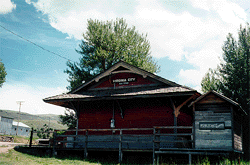
The small wooden depot building itself was not originally from Virginia City.
It was built for the Northern Pacific Railroad around 1890 in the town of Harrison, Montana, north of Ennis, where it served passengers and freight on a branch line.
Although the Northern Pacific reached towns like Alder and Harrison, it never extended tracks all the way into Virginia City, which is one reason the old mining capital slowly declined after the gold rush.
When gold dredging was active around 1900, most heavy supplies for the dredges were shipped by rail to Alder, where the large dredge boats were assembled before working their way up the gulch.
In 1964, nearly seventy years after big-scale mining ended, preservationist Charles Bovey created a new narrow-gauge tourist railroad called the Alder Gulch Short Line to connect Virginia City and Nevada City, about a mile and a half apart.
To give the line a historic-looking station in Virginia City, Bovey hired the Zion Housemoving Company to move the old Northern Pacific depot from Harrison to its current location along Wallace Street.
Locals joked about the move; one old-timer said, "I have often gone down to the depot to watch a train pull in, but this is the first time I ever went to the train and watched the depot pull in," describing how the building arrived on trucks instead of by rail.
The Alder Gulch Short Line Today
The Alder Gulch Shortline Railroad was built mainly for visitors, not freight.
Bovey bought small coal-fired Davenport "dinky" locomotives from the Anaconda Copper Mining Company and laid about a mile and a half of narrow-gauge track between Nevada City and Virginia City in 1964.
For several summers in the 1960s the little steam engines pulled passenger cars filled with tourists learning about mining history as they rode along the old gulch.
As the wooden railroad ties wore out, heavier steam engines were retired for safety, and later owners replaced them with lighter equipment and rebuilt the line in the 1990s.
Today, the Alder Gulch Shortline still runs seasonally between Virginia City and Nevada City, offering a short ride and guided narration about the area's gold rush and ghost-town past.
Even though Virginia City has a depot building, there has never been a direct rail connection from the town to the main national railroad lines; the station you see is a relocated country depot that now serves a historic tourist railroad instead of a full-size mainline.
Remembering the Chinese Community
The depot grounds also help tell the story of Virginia City's Chinese residents, whose homes once stood where the tracks and station are now.
In the 1870s, Chinese miners and merchants made up as much as one-third of the town's population, yet their cabins and temple were later removed, and no visible buildings from that community remain on the site today.
A historical marker near the depot now explains that Chinese workers reclaimed abandoned claims, shipped millions of dollars in gold back to China, and faced unfair laws and taxes that tried to push them out.
For students, the Virginia City Depot is not just about trains; it is also a place to remember the many different people-Euro-American, Chinese, and others-who shaped Alder Gulch and whose stories are still being uncovered and shared.
Credits
Special acknowledgements go to historians, preservationists, and community members whose research and work have helped preserve the Virginia City Depot, the Alder Gulch Shortline, and the stories of the people who lived and worked here.