

Frontier Life in Montana
Updated: March 23, 2026
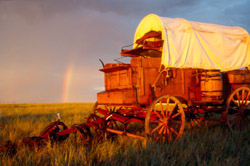
Frontier life in what is now Montana grew out of the fur trade, homesteading, and mining, all of which transformed Indigenous homelands into an American "frontier" during the 1800s and early 1900s. Current scholarship emphasizes both the opportunity these systems offered to newcomers and the profound dispossession and environmental change they caused.
Trapping, Trading, and Mountain Men
President Thomas Jefferson hoped that information from the Lewis and Clark Expedition would help open western lands to U.S. trade and influence, especially the fur trade. Using information from their journals after 1806, St. Louis merchant Manuel Lisa organized an expedition and in 1807 established Fort Raymond (also called Manuel's Fort) at the confluence of the Bighorn and Yellowstone Rivers, the first long-term Euro-American trading post in what is now Montana. From this base and later posts, "mountain men" and company employees trapped beaver and other fur-bearing animals across the upper Missouri and northern Rockies, building a trade network that tied Native nations, Euro-American trappers, and distant markets together.
Today historians and archaeologists see these early posts as both commercial centers and diplomatic spaces where traders relied on Native guides, trade partners, and kin ties, even as the growing trade increased pressure on wildlife and reshaped local economies. By the 1840s and 1850s, changing fashion in Europe and over-trapping of beaver contributed to the decline of the Rocky Mountain beaver trade, paving the way for a shift from a fur-trade frontier to one focused on agriculture and mining.
Homesteading and Settlement
The Homestead Act of 1862 and later homestead laws offered small parcels of public land to citizens (and later some immigrants) who lived on and improved their claims, presenting this as a more democratic way to access land. In practice, modern historians stress that these laws transferred land out of the public domain only after Native nations had been pushed aside by treaty, war, and policy, so "free land" for settlers rested on earlier Indigenous dispossession. In Montana, homesteading peaked after the Enlarged Homestead Act of 1909 doubled maximum claims to 320 acres and a 1912 law shortened the required residency, helping move nearly 32 million acres of Montana land from public to private hands, especially on the Northern Plains.
Homesteading in Montana was risky: low rainfall, harsh winters, and fragile prairie soils led many families to abandon claims during droughts and economic downturns. The Federal Land Policy and Management Act of 1976 formally repealed the Homestead Act nationwide, ending new homestead entries in the lower 48 and, after a transition period, in Alaska; since then, federal policy has been to retain public lands rather than dispose of them, and today individuals generally cannot obtain free public land.
Gold, Silver, and the "Treasure State"
Montana's nickname, the "Treasure State," and the motto Oro y Plata ("gold and silver") reflect the central role of mining in attracting large numbers of Euro-American settlers and capital to the region. Placer gold discoveries at Grasshopper Creek near Bannack in 1862, and soon after in Alder Gulch in 1863, triggered major rushes that created boomtowns such as Bannack, Virginia City, and Helena and helped prompt the creation of Montana Territory in 1864.] Alder Gulch became the richest of Montana's nineteenth-century gold strikes, at one point drawing around 10,000 people into a narrow mountain valley and shifting the territorial capital from Bannack to Virginia City as ores played out in earlier camps.
As easy placer deposits declined, mining shifted toward hard-rock gold, silver, and, especially in Butte, massive copper deposits that fueled later industrial growth. Historians now describe Montana's mining era as a mix of opportunity and conflict-featuring rapid town building, labor struggles, environmental damage, and fortunes made and lost-which laid much of the population and economic foundation for statehood in 1889.