

Montana Fish
Updated: February 22, 2026
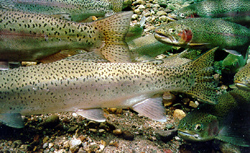
Montana's pure cold water is home to paddlefish, graylings, and cutthroat trout. From legendary trout streams to spectacular walleye reservoirs, Montana is an angler's dream. Whether casting a dry fly to a wild trout, trolling for some of the West's largest walleye, or simply drifting a baited hook through the old fishing hole, Montana has it all. Montana is noted for its blue-ribbon streams!
One of Montana's most famous native fish is the westslope cutthroat trout, the state fish. It once swam in nearly every cold stream west of the Continental Divide and still wears its 'cutthroat' name proudly with bright red or orange slashes under its jaw. These trout can range from about 6 to 16 inches long and live in clear, cold creeks where they rise eagerly to eat insects off the surface perfect for kids learning to fly fish. Another native trout, the Yellowstone cutthroat, is found in the Yellowstone River system; some anglers travel from all over the world just to catch and release one of these golden-spotted fish in the Yellowstone or Lamar Rivers.
Montana also has a small, special population of fluvial Arctic grayling, a silvery fish with a big sail-like dorsal fin that looks almost like a fish wearing a flag on its back. These grayling survive mainly in the upper Big Hole River, and biologists have created special rules to help protect them.
In the big prairie rivers and reservoirs, you can meet the strange-looking paddlefish, a huge ancient fish with a long flat 'paddle' nose. Paddlefish in Montana can live 40-50 years, and the state-record fish weighed 142.5 pounds and was 77 inches long?longer than many sixth-graders are tall! These plankton-eating giants usually aren't caught with regular lures; during special seasons, anglers 'snag' them with big treble hooks, and every year people line the banks of the Yellowstone and Missouri Rivers hoping for a once-in-a-lifetime catch.
Some of Montana's rivers are officially labeled 'blue-ribbon' trout streams, which means they have excellent water quality, lots of wild trout, and good public access. Famous examples include the Madison, Missouri, Yellowstone, Big Hole, and Bighorn Rivers, where some stretches hold over 1,000 trout per mile. On these waters, you might see drift boats floating downstream while anglers try to match the hatch-picking flies that look exactly like the insects trout are eating at that moment.
Because these native fish are so important, Montana Fish, Wildlife & Parks has special regulations to protect species like westslope cutthroat trout, Yellowstone cutthroat trout, bull trout, and Arctic grayling, often requiring catch-and-release only. When kids and families learn to handle fish gently, keep them in the water, and follow the rules, they help make sure Montana's 'underwater wildlife' will still be there for the next generation of young anglers to discover.