

Sacagawea
Updated: March 2, 2026
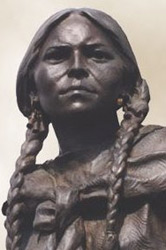
Meriwether Lewis and William Clark met Sacagawea in the winter of 1804-1805 at the Mandan-Hidatsa villages in present-day North Dakota, when she was a teenager who had recently given birth to her first child. Most historians agree that she was born into a Shoshone community near the Lemhi River in today's Idaho or Montana border region, captured around age 12 by a Hidatsa raiding party, taken down the Missouri River, and later entered into a non-consensual marriage arrangement with the French Canadian trader Toussaint Charbonneau. By the time the Corps of Discovery built Fort Mandan, Charbonneau was living among the Hidatsa, and his household included Sacagawea, who was then pregnant with a son the captains would call Jean Baptiste.
Lewis and Clark hired Charbonneau as an interpreter in late 1804, but it soon became clear that Sacagawea's linguistic skills and cultural knowledge were just as important as his. She spoke Shoshone and Hidatsa, while Charbonneau spoke Hidatsa and French; another interpreter, François Labiche, spoke French and English, so messages often passed through a chain from English to French to Hidatsa to Shoshone and back again. When the expedition left Fort Mandan on April 7, 1805, Sacagawea traveled with the Corps as its only woman, carrying four-month-old Jean Baptiste (nicknamed "Pomp" or "Pompée") on her back. Her presence, along with the baby, signaled peaceful intentions to many Native communities they met, because war parties on the Plains and Plateau did not typically travel with women and infants.
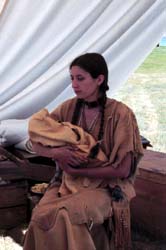
Sacagawea's practical courage appears repeatedly in the journals. On May 14, 1805, when a pirogue Charbonneau was steering nearly capsized in high wind on the upper Missouri, Sacagawea calmly stayed in the boat and saved important papers, instruments, medicines, and trade goods as others struggled to control the craft, a feat Lewis praised in his journal as a sign of her "fortitude and resolution." Throughout the expedition she gathered edible roots and plants, helped prepare food, and served as a visible symbol of peaceful intent when the Corps entered unfamiliar villages and camps. Despite this contribution, she was not paid separately for her work; payment for services went to Charbonneau, reflecting both the gender norms and power imbalances of the time.
After the expedition reached the Pacific and returned to the northern Plains, Sacagawea and Charbonneau parted ways with the Corps in 1806 and remained in the Upper Missouri region, occasionally reconnecting with former expedition members. In 1809, Charbonneau brought Sacagawea and Jean Baptiste to St. Louis at William Clark's invitation; Clark arranged for Jean Baptiste's education and, in legal documents, referred to both Sacagawea's children-Jean Baptiste and a daughter often called Lisette-as his wards. The best-supported documentary evidence, including contemporary trading-post and missionary records, indicates that Sacagawea likely died at or near Fort Manuel Lisa on the upper Missouri (in what is now South Dakota) around December 1812, probably from illness. Later oral traditions among some communities place a woman identified as Sacagawea living into the 1880s on the Wind River Reservation in Wyoming or in northeastern Montana, but most historians now regard those accounts as referring to a different woman, noting that detailed research on Fort Manuel's records strongly supports an 1812 death for the expedition's Sacagawea.
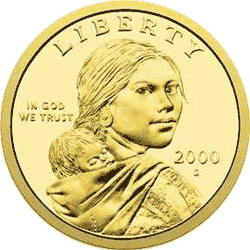
Test you knowledge. Take the Sacagawea quiz now!
US Mint.