

Jack Horner
Updated: February 26, 2026
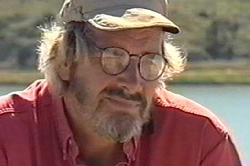
Every day Montanans walk across the very same ground dinosaurs once inhabited. Was Montana a teaming jungle filled with giant, flesh-ripping monsters 72 million years ago? Not exactly—and the scientist who has done the most research on the day-to-day life of dinosaurs is Montana State University’s Jack Horner.
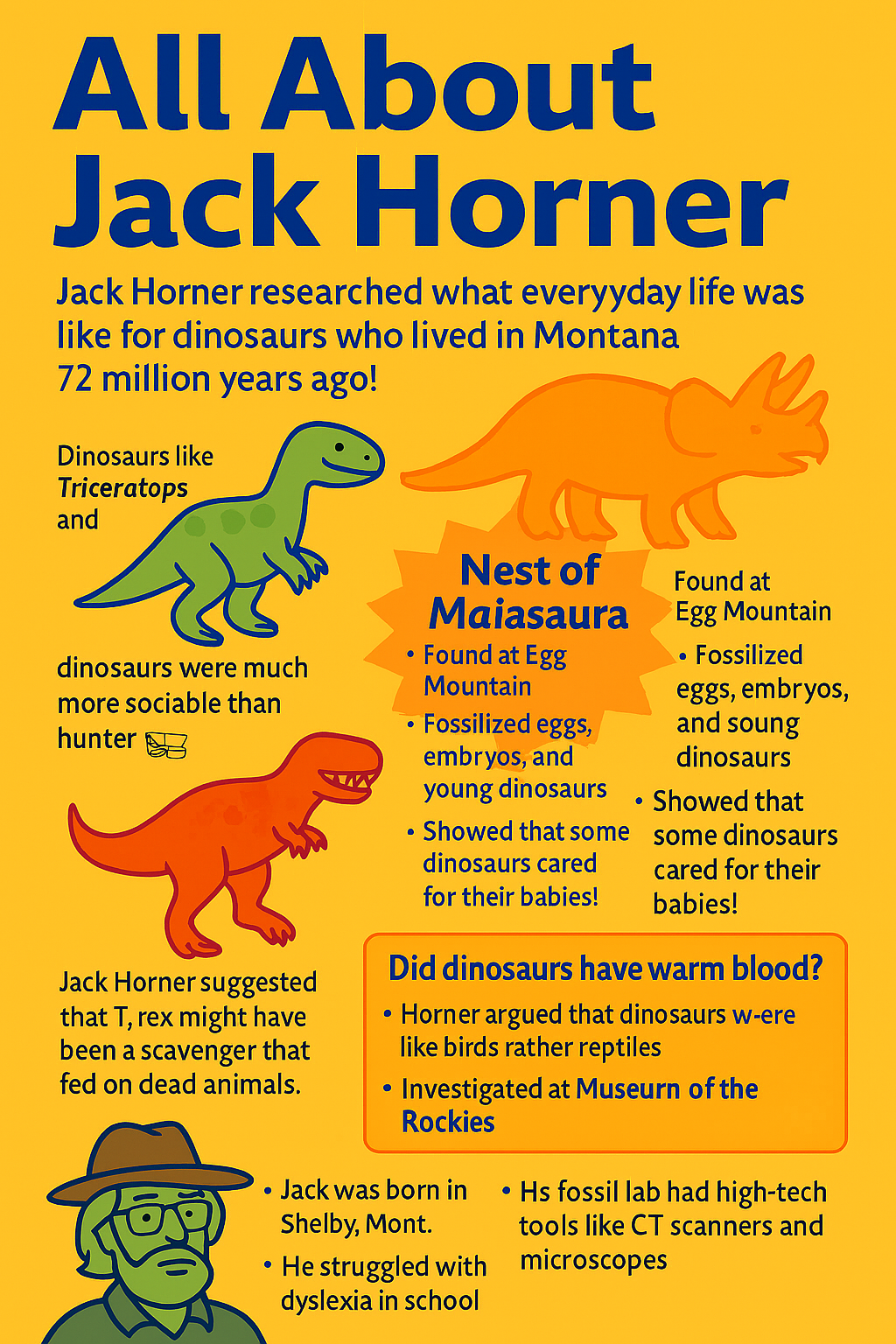
Some of Horner's most surprising theories changed how we see dinosaurs. He showed that many dinosaurs were social animals, living in large herds-he famously called them "the cows of the Mesozoic." His research also challenged the old image of Tyrannosaurus rex as a relentless predator. Horner suggested T. rex may have been more like a scavenger, similar to a modern hyena. And what about dinosaur body temperature? Horner helped spark the debate over whether dinosaurs were warm-blooded, cold-blooded, or something in between. These fascinating questions are explored at Montana's Museum of the Rockies, Horner's former home base.
Jack Horner, the fossil hunter born in Shelby, Montana, even inspired the character of Alan Grant in the movie *Jurassic Park*. He found his first dinosaur fossil at age eight. Though he struggled in school, he excelled at science projects-famously launching a rocket 15,000 feet at 800 miles per hour from a local airport! After high school and a stint in the Marines, Horner returned to college and discovered his passion for fossils. Despite studying paleontology for seven years, he never earned a degree-later learning his academic challenges were due to dyslexia. That didn’t stop him. He eventually landed a job at Princeton University and went on to make discoveries that changed paleontology forever.
Horner's approach is hands-on and practical. He dislikes rigid academic traditions and prefers the field to the lecture hall. At the Museum of the Rockies, his lab is equipped with cutting-edge tools: CT scanners for fossils, a microbiology lab for bone studies, and even DNA analysis equipment for exploring ancient proteins.
Among his most famous discoveries is the nesting site of Maiasaura, the "Good Mother Lizard," at Egg Mountain in north-central Montana. This site revealed fossilized eggs, embryos, and hatchlings-proving for the first time that some dinosaurs cared for their young. Horner's work showed that Maiasaura lived in large colonies and fed their babies, much like modern birds. This discovery revolutionized our understanding of dinosaur behavior.
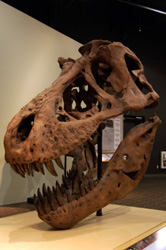
Horner also uncovered one of the most complete Tyrannosaurus rex skeletons ever found in Montana. Today, visitors to the Museum of the Rockies can see fossils displayed as they were discovered, offering a rare glimpse into the evidence scientists use to build theories about life millions of years ago.
Jack Horner retired from his position as Curator of Paleontology at the Museum of the Rockies (MOR) and Montana State University (MSU) in June 2016, after building the museum's renowned dinosaur collection, but he remains an influential figure, continuing his work as a Presidential Fellow at Chapman University and focusing on applying his unique approach to paleontology and education
Latest Updates (2026)
- Egg Mountain was designated an International Geoheritage Site in 2025, recognizing its global importance.
- The Museum of the Rockies opened its new exhibit, "Cretaceous Crossroads," in 2025, featuring Maiasaura nests and fossils from the Two Medicine Formation.
- Horner's research continues to influence debates on dinosaur metabolism, growth rates, and social behavior. Studies confirm that Maiasaura grew rapidly-up to 10 feet in one year-supporting the idea of warm-bloodedness.
- Montana remains a world leader in paleontology, with ongoing discoveries of hadrosaurs, ceratopsians, and tyrannosaurids that reshape our understanding of the Cretaceous ecosystem.