

Overview
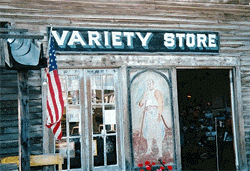
The building known today as the Variety Store is a careful reconstruction of an early Virginia City shop.
The front of the building matches the original storefront design, but the new structure is made of sturdy concrete blocks instead of the wood framing used in the 1800s, to help it last longer and resist fire.
Early Auctions and the "Blue Front"
The first business in the original building was run by a man named Mr. Cook, who used it as an auction store in the 1860s.
Auctions were a big part of life in Alder Gulch, where people gathered to bid on tools, clothing, food, and even mining claims, turning sales into lively social events as well as business.
In November 1866, a novelty store opened in the same location, replacing Cook's auction room with shelves of small, interesting goods.
Soon after, merchant O. P. Raymond advertised the items he planned to sell at his new novelty store, including basic foods like apples along with many other trade goods.
He chose a simple, descriptive name-"Blue Front"-because he had the front of the store painted bright blue, making it easy for customers to spot along the busy street.
Later Owners and Removal of the Original Building
In 1872, William Douglas bought the variety store business, and later he sold it to William A. Buttermore.
Buttermore ran the store until his death around 1910, serving local families and miners with a changing mix of supplies, treats, and household items.
Sometime in the 1920s, long after the first gold rush had ended, the original wooden building was removed, like many other fragile frontier structures that could not stand up to time and weather.
Rebuilding as a Penny Arcade
Decades later, preservationist Charles Bovey wanted visitors to see what the old variety store area might have looked like, so he had the present building constructed as a reproduction of the 1860s shop.
The new structure, with its duplicated front, was designed to blend in with the rest of Virginia City?s historic streetscape while being strong enough for modern use.
Inside, Bovey installed a penny arcade filled with early 1900s coin?operated machines, such as mechanical music players, fortune tellers, and moving picture viewers from around 1910.
The arcade operated for many years, giving visitors a chance to experience the kinds of entertainment people enjoyed before video games and smartphones.
Why the Variety Store Matters Today
Today, the rebuilt Variety Store (also called the Blue Front Variety Store or Gypsy Arcade in some records) remains part of Virginia City?s historic district, helping students and visitors imagine both the world of nineteenth?century auctions and novelty goods and the fun of early twentieth-century penny arcades.
Credits
Special acknowledgements go to local historians and preservationists whose research and restoration work have helped keep the story of the Variety Store and Virginia City alive for new generations.