

A Busy Corner in 1863
In 1863, this lot in Virginia City held a small brewery and bakery operated by Nicolas (Nick) Kessler, a German immigrant who followed the gold rush to Alder Gulch. Miners needed bread, beer, and everyday supplies as much as picks and shovels, so Kessler's business quickly became important in the young mining camp. A few years later Kessler moved to Helena, where he started a larger brewery and ran brickyards that produced "Kessler bricks" used in many of that city's early buildings. His time in Virginia City shows how early entrepreneurs used mining towns as stepping stones to bigger businesses elsewhere in Montana.
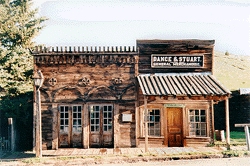
Dance and Stuart's General Store
By the fall of 1863, partners Walter B. Dance and James Stuart had rented the building from owner William Reuman and opened one of Virginia City's finest mercantile stores. Dance, born in Delaware in 1820, reached Gold Creek, Montana, in 1862 and soon became an important community leader. He served as Virginia City's second postmaster from May 9 to November 4, 1864, and during that time the post office was almost certainly located inside the Dance and Stuart store. James Stuart and his brother Granville had arrived in Montana in 1857 from Iowa, where they became well-known prospectors, ranchers, and writers who helped open and describe many of the territory's mining regions.
A Store Where History Happened
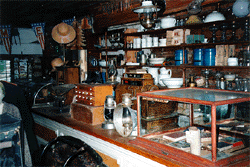
The Dance and Stuart General Store sold food, tools, clothing, and mining supplies, similar to a modern general or hardware store. It also became the setting for dramatic and important events. One story says that George Lane-later known as "Clubfoot George"-was arrested here by members of the Vigilantes before he was tried by the citizen group and hanged as a suspected road agent. Even more significant, a meeting held in this store on February 25, 1865, led to the creation of the Historical Society of Montana, the organization that later became the Montana Historical Society. Because of that early decision, Montana now has collections of letters, photographs, maps, and objects that reach back to the first gold-rush years.
What Happened After Dance and Stuart Left
In 1865, Dance and Stuart moved their main store to Deer Lodge, where their partnership continued until around 1870. In 1867, they joined with blacksmith George Thexton-known for turning the nearby Vigilante Barn into a livery stable-to purchase the old store building. Over the next decades, the structure was used mostly as a dwelling and later became a "Chinese house," meaning it was home to Chinese residents who worked in Virginia City and nearby mining claims. One of the last known residents was a woman remembered as Mrs. Parker around 1900, and the original log building appears to have been torn down about 1925 after many years of changing uses.
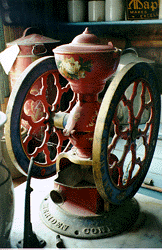
Iron Coffee Mill Grinder in Dance and
Stuart General Store
Rebuilding the Store in the 1950s
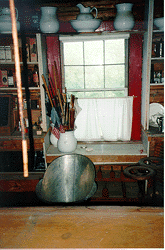
The building visitors see today is not the original 1860s structure but a careful reconstruction built in the mid-1950s by Charles and Sue Ford Bovey, who worked to preserve Virginia City's ghost-town history. Using old photographs, drawings, and written descriptions, they built an almost exact copy of the original Dance and Stuart store on the same site. The logs for the new structure were hauled from abandoned buildings at the Kearsarge mine near Summit, another historic mining site in the Alder Gulch region. Inside, the store is furnished with shelves, counters, an iron coffee mill, and period goods to show what a complete late-19th-century general store in Montana looked like.
Why This Site Matters Today
Today, the reconstructed Dance and Stuart General Store helps students and visitors imagine the sounds, smells, and busy routines of shopping in a frontier mining town. It also reminds people that important ideas and organizations, like the Montana Historical Society, sometimes begin in simple places such as a wooden store rather than in grand government buildings. Historians and archaeologists continue to study letters, business records, and site reports to learn more about the original store, the people who lived there later, and the Chinese community that once occupied the building.
Acknowledgements
Special acknowledgements go to John D. Ellingsen, John N. DeHaas, Tony Dalich, Ken Sievert, Tom Cook, and Ellen Baumler of the Montana Historical Society, whose research and interpretation have helped share the history of the Dance and Stuart General Store with students and visitors.