

Photograph Archives. Material may be protected by
copyright law (Title 17 U.S. Code)
The First Brick Building
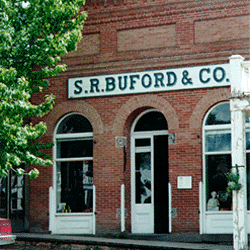
In the summer of 1875, clothing merchant E. J. Walter built Virginia City's first brick building on the site of his earlier wooden "Overland Clothing Store," just east of the Wells Fargo office on Wallace Street. The store's red brick walls, rounded arches, and tall front made it stand out among the many log and frame buildings in the mining town. The bricks are believed to have been made locally, showing that by the mid-1870s Virginia City had enough skilled workers and equipment to produce its own building materials. Other brick structures, such as the Madison County Courthouse and the Virginia City school, followed soon after, but Walter's store is widely recognized as the earliest surviving brick building in town and may be one of the oldest standing brick buildings in Montana.
From E. J. Walter to S. R. Buford
Building in brick was expensive, and the cost proved too high for Walter to manage for long. Within a short time, the building came under the control of banker and investor Henry Elling, who rented it to a freighter named Simeon R. (S. R.) Buford. Before opening his store, Buford had driven ox-team freight wagons between Virginia City and distant towns such as Fort Benton and Corinne, Utah, hauling goods in and gold shipments out. In 1878, backed by Elling, he opened S. R. Buford & Company in the brick building, turning it into a busy mercantile store that served miners, ranchers, and families across Madison County.
A "One-Stop" Frontier Store
Buford had a strong talent for business and soon grew his company into the largest store in the region. At first he sold groceries and liquor, but he quickly expanded to offer hardware, heavy steel, farm machinery, wagons, and mining supplies, making his business a kind of "one-stop" store where people could buy almost anything they needed. In 1886, he added a matching brick section to the west, giving the store a wider, more impressive front along Wallace Street. In 1899, workers tore down the old Wells Fargo office that stood between the two brick sections and built a roof across the gap, creating one large, modern grocery department while turning the original east side into the hardware department. S. R. Buford & Company remained important into the early 1900s, and Buford's son Henry continued operating the business into about 1920.
More Than Just a Store
As his store prospered, Buford invested in other enterprises, often working with his partner and friend Henry Elling. He helped found the Elling State Bank and later served as its president, showing how merchants and bankers helped create more permanent communities after the first rush of gold slowed down. Store account books and letters from S. R. Buford & Company reveal that it traded with ranches, mining camps, and companies across Montana and beyond, turning Virginia City into a marketing center for southwest Montana. For local families, the store was not only a place to buy flour, tools, and clothing but also a social center where neighbors met, shared news, and stayed connected.
Restoration and the "New Old" Grocery
In the mid-1900s, Charles and Sue Ford Bovey began buying and restoring historic buildings in Virginia City to protect its gold-rush history. They acquired the Buford Store building in 1947 and first used the east section as a gift shop for visitors exploring the ghost town. As more gift shops opened along Wallace Street, the Boveys chose to use the space to teach history instead of running another store, so in 1975 they carefully reconstructed the original S. R. Buford grocery inside the building. They used Buford's original counters, shelves, and other fixtures and even displayed old canned goods and product labels that Buford had saved in his papers, giving visitors a clear picture of what a late-1800s Montana mercantile looked like.
The Buford Store Today
Today, the Buford Store building still shows its 1870s brick front with arched windows facing Wallace Street in Virginia City. It stands with many other preserved buildings as part of the Virginia City National Historic Landmark district, helping students and visitors imagine the sights, sounds, and daily routines of a lively frontier town. Inside, exhibits and furnished interiors allow people to see how goods were displayed, how counters were arranged, and what kinds of products families bought more than a century ago. Ongoing research and preservation work also help keep the building stable in Montana's harsh climate so future generations can continue to learn from it.
Acknowledgements
Special acknowledgements go to John D. Ellingsen, John N. DeHaas, Tony Dalich, Ken Sievert, Tom Cook, and Ellen Baumler of the Montana Historical Society, whose research and interpretation have helped share the story of the Buford Store with students and visitors.