

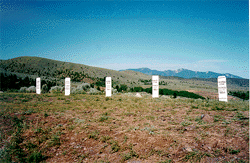
Where Boot Hill Is and How It Got Its Name
Boot Hill is a small cemetery on a ridge just north of Virginia City, Montana, above a place called Daylight Gulch. Visitors today can hike or drive up from town and look down on the old mining camp and the gulch below. The name "Boot Hill" was used in several western towns for graveyards where men who died violently were said to have been "buried with their boots on." In Virginia City, this hill became the final resting place for five men the local Vigilantes said were "road agents," or robbers who attacked travelers and gold shipments.
The Hanging of the Road Agents
In the winter of 1863-1864, many robberies and killings along the roads near Virginia City and Bannack frightened miners and merchants carrying gold. A secret group of citizens formed a "vigilance committee," called the Vigilantes, and began capturing and hanging men they believed were part of a gang of road agents. On January 14, 1864, five men-Hayes Lyons, Boone Helm, Frank Parish, George "Clubfoot" Lane, and Jack Gallagher-were hanged near Virginia City and then buried on the hill now known as Boot Hill. Historians today agree that crime was real and serious, but they also note that the Vigilantes acted without regular trials, so some men may have been executed on weak or uncertain evidence.
Lost and Rediscovered Graves
At first, the five graves on Boot Hill had no markers, and over time wind, rain, and grass slowly hid the exact spots. For many years, people in town walked past the hill without clear signs of who was buried there. About forty-three years later, in 1907, residents began to worry that they were forgetting an important piece of their history and started talking about putting up grave markers. A man named A. B. Davis, who said he had been a Vigilante, claimed that he still remembered where each man had been buried, especially which grave belonged to Clubfoot George. An offer of one hundred dollars from people in Butte helped encourage the town to check Davis's story and finally mark the graves.
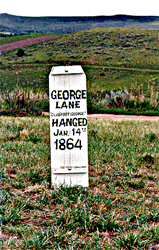
Digging Up "Clubfoot George"
In 1907, James G. Walker was the mayor of Virginia City, and he decided to test whether A. B. Davis truly knew the location of the graves. Other former Vigilantes agreed that if Davis could correctly point out the grave of George Lane, nicknamed "Clubfoot George," then they could identify the others because they still remembered the order of the burials. Walker ordered the grave Davis pointed out to be opened, and when the coffin was uncovered, the body inside was identified by its clearly deformed foot, showing that this was indeed Clubfoot George. This discovery proved that Davis's memory of the hill had been accurate after more than forty years.
Coffins, Not Just Blankets
Some local stories had claimed that the road agents were buried quickly in blankets, without coffins. When Mayor Walker opened the grave, however, he found that the body was inside a wooden coffin that was still in surprisingly good condition. A report in the local newspaper, the Madisonian, said that the casket was so well preserved that Mayor Walker took a piece of the wood to show others. This new evidence helped correct the old myth and gave historians a clearer picture of burial practices in early Virginia City.
What Happened to the Foot
Mayor Walker also removed the deformed foot bones from the grave and placed them, along with the casket piece, in a cabinet of curiosities at the courthouse. Later, the foot was displayed under a glass cover at the Thompson-Hickman Museum in Virginia City, where it became a famous and sometimes unsettling object for visitors learning about Boot Hill. In the 2010s, descendants of George Lane asked that the foot be returned; it was cremated, and in June 2017 the ashes were scattered on Boot Hill during a small family ceremony. Today, museum staff and teachers use the story of the foot to discuss how we respect human remains and remember people from the past, even when they were accused of serious crimes.
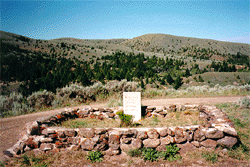
Two Cemeteries on the Ridge
The Boot Hill ridge actually holds more than one cemetery. On the hilltop, the graveyard of the five hanged men became known for its connection to "outlaws" and dramatic vigilante justice. To the east, on the same ridge, another cemetery developed for people the town considered more "respectable," who were buried in regular city plots with family markers. This separation shows that early communities sometimes treated people differently even after death, depending on their reputation and how they died.
How Historians See Boot Hill Today
Modern historians use newspapers, letters, court records, and archaeology to study what really happened around Virginia City's Vigilantes and Boot Hill. Many agree that some of the men on Boot Hill probably took part in robberies, but they also warn that the Vigilantes acted outside the regular legal system and may have executed some men mostly on suspicion or fear. Today, Boot Hill is both a tourist stop and a learning place, where visitors can think about frontier justice, the dangers of the gold-rush era, and the importance of fair trials and strong evidence. Thanks to researchers such as Ellen Baumler and other Montana historians, the story of Boot Hill continues to be updated as new records and family stories appear.
Acknowledgements
Special acknowledgements go to John D. Ellingsen, John N. DeHaas, Tony Dalich, Ken Sievert, Tom Cook, and Ellen Baumler of the Montana Historical Society, whose work has helped share this history with students and visitors.