

Bannack Ghost Town
Updated: February 20, 2026
Bannack is one of Montana's best-preserved ghost towns and a state park where visitors can walk through real buildings from the 1860s gold rush and imagine life in an early mining town.
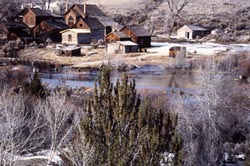
Gold at Grasshopper Creek
In July 1862, a small group of prospectors led by John White found gold in a stream they named Grasshopper Creek, starting one of Montana's first big gold rushes.
By the end of that year about 400 to 500 miners were working along the creek, and by the next spring around 1,000 people had crowded into the new camp they named Bannack City after the nearby Bannock people.
Most people lived in tents or rough wooden shacks crowded along the water, because the faster you reached the creek, the better your chance to find gold.
Miners used simple tools such as pans, rockers, and sluice boxes to wash away lighter sand and gravel, leaving the heavier gold behind in the bottom.
Building a Boomtown
Like many gold camps, Bannack quickly grew from scattered tents into a town with stores, saloons, a hotel, blacksmith shops, and other wooden buildings along a dirt main street.
During the American Civil War, miners who supported the Union camped in an area called "Yankee Flats," while men with Southern loyalties camped across Grasshopper Creek near where the main part of Bannack now stands.
In 1864, the United States created the Territory of Montana, and Bannack was chosen as the first territorial capital for about one year before the capital moved to Virginia City.
The first territorial legislature met in Bannack, passed early laws for the new territory, and approved a design for a territorial seal, making the town briefly the political center of the region.
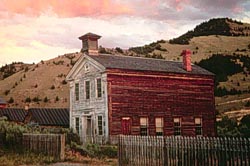
Gold fields during the Civil War
When gold was discovered at Grasshopper Creek in 1862, miners rushed to Bannack and other Montana camps to look for riches.
They dug placer gold out of the streams, turned it into dust and nuggets, and then shipped it east along wagon roads and river routes.
Once it reached big cities, this gold could be sold or traded for money in banks and markets.
How the Union used the gold
Leaders in the United States, including President Abraham Lincoln, understood that gold from the West could be turned into cash to buy food, uniforms, weapons, and other supplies for the Union army.
Because of this, the Union tried to protect some of the routes going into the Montana gold fields so more loyal settlers could travel safely and more of the gold would stay under Union control.
A divided mining camp
Life in Bannack itself showed how divided the country was, even in a remote mining camp.
Miners who supported the North camped in an area called "Yankee Flats," while many men with Southern, or Confederate, sympathies camped across Grasshopper Creek.
The gold they dug from the same hills could end up helping families, businesses, and causes in both the North and the South, even though the battles were being fought thousands of miles away.
Crime, Vigilantes, and Changing Views
Early Bannack had almost no official law or courts, and robbery and murder became common along the rough 70-mile road between Bannack and the new gold fields at Alder Gulch near Virginia City.
Some citizens in the mining camps formed vigilante committees-private groups who claimed they were enforcing order-and they later used the mysterious numbers "3-7-77" as a warning symbol in Montana.
Henry Plummer was elected sheriff of Bannack in 1863, and soon some residents accused him of secretly leading a group of stagecoach robbers sometimes called the "Innocents."
In January 1864, vigilantes arrested Plummer and two of his deputies and hanged them without a trial, along with many other suspected "road agents" in the region.
For many years people repeated the story that Plummer led a large organized gang that robbed and killed more than 100 men, but modern historians have found little solid evidence for such a big, well-run gang.
Some researchers now think at least part of the Plummer and "Innocents" story was exaggerated and that the legend helped justify the vigilantes' own unlawful hangings.
From Gold Rush to Ghost Town
The first gold at Bannack was placer gold-loose grains in sand and gravel-that was fairly easy to reach with simple tools, and miners removed millions of dollars' worth in a short time by 19th-century prices.
When richer gold deposits were discovered in 1863 at Alder Gulch, where Virginia City would grow, many miners quickly left Bannack to chase the new strike, and the older camp began to shrink.
As time passed, some Bannack miners dug underground lode mines into solid rock and used heavy stamp mills to crush ore and free gold that was locked inside the rock itself.
In the late 1800s and early 1900s, large dredges-floating machines like giant mechanical shovels'chewed up the creek bottom, using powerful water jets and screens to capture remaining fine gold from the gravel of Grasshopper Creek.
Bannack's population never again reached its boom-time peak, and by the early 1900s most easy gold was gone and only a few hundred people still lived in town.
The last permanent residents moved away by the mid-1900s, leaving empty streets, weathered wooden buildings, and scattered mining equipment across the valley-what we now call a ghost town.
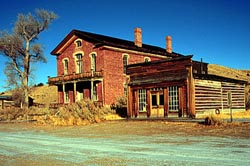
Bannack Today
Today, Bannack is protected as Bannack State Park and as a National Historic Landmark, with more than 50 historic buildings still standing along the old main street and nearby hillsides.
Important buildings that visitors can see include the Meade Hotel, the two-story schoolhouse, the Masonic Hall, Skinner's Saloon, and the hilltop cemetery often called Boot Hill.
Montana manages Bannack so that the buildings are preserved but not completely rebuilt, allowing visitors to see original walls, old wallpaper, and mining tools much as they looked when residents left in the 1940s.
During the year, visitors can walk through many buildings, try gold panning at the park, camp nearby, and join guided tours that explain both the famous legends and what historians now believe really happened.
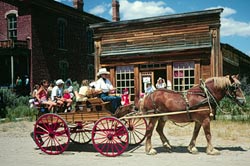
On a special weekend in July, volunteers in period clothing reenact scenes like stagecoach holdups, town meetings, and everyday chores, briefly bringing the ghost town back to life for families and students.