

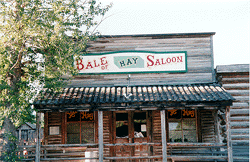
From Grocery Store to "Bale of Hay"
The building that now holds the Bale of Hay Saloon was first used as a grocery and liquor business run by J. F. Stoer starting around 1869, serving miners and townspeople in Virginia City. In the late 1880s Stoer sold the building, and by the 1890s businessmen Smith and Boyd took over and turned it fully into a saloon.
Because they also owned the livery stable next door, they jokingly named their bar the "Bale of Hay," referring to the hay bales stacked outside for the horses at the stable. Smith and Boyd ran the Bale of Hay Saloon until about 1908, after which the building sat empty for several decades as Virginia City's boom years faded.
Bovey Restoration and Movie Fame
In the 1940s Charles and Sue Bovey began buying historic buildings in Virginia City and Nevada City to keep them from being torn down or used as firewood. Charles Bovey acquired the Bale of Hay building in 1946, added the front porch, and reopened it as a working saloon, keeping much of the old interior just as he found it.
The impressive carved back bar and mirror inside the Bale of Hay today did not start out there; they came from an 1880s saloon in Benchland, Montana, and were moved in during the Bovey restoration. Animal trophy heads on the walls, old amusement machines, and the angled ceiling helped make the Bale of Hay a perfect film set for saloon scenes in the 1970 movie Little Big Man starring Dustin Hoffman.
Fire and Careful Rebuilding
In 1983 a fire broke out at the rear of the Bale of Hay Saloon, destroying the roof but leaving much of the floor and some walls standing. Firefighters from Virginia City and nearby towns stopped the flames from spreading to other historic buildings, but to reopen the saloon the owners had to rebuild the inside to meet modern safety codes.
Workers poured a new concrete foundation several feet deep and built new stud walls and sheetrock inside the old exterior shell, then restored the interior appearance so it still looked like a 19th-century saloon to visitors. The Bale of Hay reopened in 1985, and many people today recognize its ceiling and potbelly stove from both the movie and old photographs.
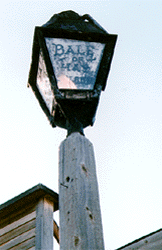
Bale of Hay Saloon
The Bale of Hay and the Virginia City Players
The Bale of Hay also helped revive live theater in Virginia City. In 1948 Charles Bovey invited Dori and Larry Barsness to create a show for a miners' convention, and they quickly set up a small platform stage inside the Bale of Hay Saloon for a short melodrama.
The success of that show led to the creation of the Illustrious Virginia City Players, one of the longest-running summer theater groups in the West. In 1947 the Boveys built a log addition behind the Bale of Hay to give the Players a bigger stage, because the front room was too small for large productions.
That log structure now links the Bale of Hay to the Virginia City Opera House, which was converted from an old stone barn into a 19th-century-style theater where the Players perform melodramas and vaudeville shows in the summer.
Montana's Oldest Bar Today
In 1997 the State of Montana bought the Bovey properties, including the Bale of Hay, and created the Montana Heritage Commission to preserve and manage Virginia City's historic buildings. The Bale of Hay Saloon is now leased to private operators but is still owned by the state and opens mainly during the summer tourist season.
Today the Bale of Hay serves food and drinks and hosts events while keeping many original-style details, such as period artwork, the famous "Nymphs and Satyr" painting, and hitching posts outside for riders on horseback. Visitors can sit beneath the old bar mirrors and ceiling, look at photos from movie shoots and past decades, and think about how one small building has changed from frontier grocery to saloon, movie set, music hall, and community gathering place over more than 150 years.