

Cromwell Dixon: Montana's Boy Aviator
Updated: February 24, 2026
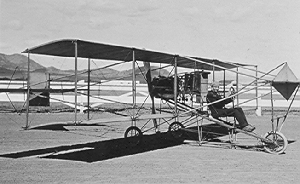
Cromwell Dixon was a teenage pilot who became the first person to fly an airplane across the Continental Divide near Helena, Montana, in 1911.
Who Was Cromwell Dixon?
Cromwell Dixon was born in 1892 in Columbus, Ohio, and he loved building machines from a very young age. As a child he built things like a homemade roller coaster and even a motorcycle before he was a teenager. He later became famous across the United States as the "Boy Aviator" because he was so young and so skilled at flying early airplanes.
His Early Inventions: The Skycycle
When Cromwell was about 13, he began building a flying machine that people called the "skycycle," or "sky bicycle." It was a small airship with a big silk gas balloon on top and a bicycle-like frame underneath that he powered with pedals connected to a propeller and controlled with steering lines. He finished this invention in 1907 and made flights above the Columbus Driving Park racetrack, where crowds came to watch him pedal through the sky.
The skycycle made Cromwell a local celebrity, and newspapers wrote about him as one of the youngest inventors and aeronauts in the world. He used the skycycle at fairs and shows, and once even had to save it from a fire started by an arsonist. Although the gas-filled balloon and wooden frame were fragile compared with today's aircraft, his flights helped people imagine new ways to travel in the air.
Becoming an Airplane Pilot
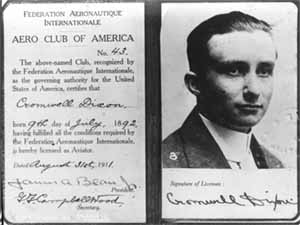
After his success with the skycycle, Cromwell wanted to fly heavier-than-air machines, which we now simply call airplanes. His mother agreed to let him join the Curtiss Exhibition Company of New York, a group that put on flying shows with Curtiss "Pusher" biplanes. On August 11, 1911, he earned pilot's license number 72 from the Aero Club of America, making him the youngest licensed pilot in the United States at that time.
Cromwell quickly became known for daring stunts at fairs and exhibitions around the country. He practiced steep dives, sharp turns, and spiral maneuvers that thrilled audiences but were very risky because early airplanes had weak engines, light wooden frames, and almost no safety equipment. These shows were one of the only ways pilots could earn money, so many of them took big chances in the air.
The "Dixon Corkscrew"
Cromwell became famous for a move that reporters called the "Dixon Corkscrew." In this stunt, he would guide his biplane into a tight spiral, dropping quickly toward the ground from high in the sky and then leveling out just before landing. A maneuver like this tested both the strength of the airplane and the pilot's ability to stay calm and react quickly.
Pilots in the early 1900s did not have radios, parachutes, or strong metal cabins to protect them. If something broke or the wind suddenly shifted during a stunt like the corkscrew, there was almost no way to avoid a crash. Cromwell's courage and skill impressed many people, but his work was always dangerous.
The Historic Flight over the Continental Divide
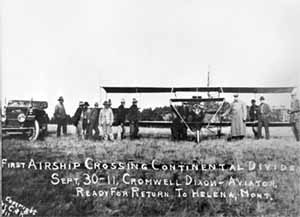
On September 30, 1911, thousands of people gathered at the Lewis and Clark County fairgrounds in Helena, Montana, to watch Cromwell attempt a record-setting flight over the Continental Divide. Local leaders and businessmen had offered a prize of $10,000 to the first pilot who could fly an airplane across the Divide, which is a long line of mountains that separates the rivers that flow to the Pacific Ocean from those that flow to the Atlantic.
Cromwell flew a Curtiss "Pusher" biplane, which had its engine and propeller behind the pilot and a simple wooden frame covered with fabric. That clear, calm autumn afternoon he took off from Helena at about 2:08 p.m. and climbed to more than 7,000 feet as he headed west through Mullan Pass. After about 26 minutes in the air and roughly 15-17 miles of flight, he landed safely near Blossburg, Montana, on the west side of the Divide.
By completing this trip, Cromwell became the first person to fly an airplane across the Continental Divide, a major milestone in aviation history. That same afternoon he took off again and flew back to Helena, but the return flight was harder because strong winds made it difficult for him to reach the right altitude, and it took about 43 minutes. Montana's governor, Edwin L. Norris, presented him with the $10,000 prize, which was a huge amount of money at the time.
Cromwell's Final Days
Only two days after his famous Montana flight, Cromwell traveled to Spokane, Washington, to perform at the Interstate Fair there. On October 2, 1911, he flew his biplane in front of a crowd of thousands. During one of his flights that afternoon, his plane got caught by a sudden gust or downwind while it was already tilted in a turn, and it fell from about 100 feet into a railroad cut near the fairgrounds.
The heavy engine crushed the front of the fragile airplane, and Cromwell was badly injured. He was taken to a hospital in Spokane but died less than an hour later at just 19 years old. Newspapers in Helena and other cities described how deeply people mourned him, saying that no one had ever won over the city's hearts as quickly as the boy aviator had during the state fair.
How People Remember Cromwell Dixon Today
Even though Cromwell lived a very short life, his flights showed that airplanes could cross high mountains that once seemed like impossible barriers. His success helped convince many people that aviation had a future beyond simple shows and stunts. In 1912, a monument was set up to honor his Continental Divide flight, and that monument now stands in Morrison Park in Helena.
In the Helena area, Cromwell Dixon's name lives on at Cromwell Dixon Campground near the top of the Continental Divide and on Cromwell Dixon Lane near the Helena Regional Airport. A plaque at the airport and local history displays also tell the story of the boy aviator so new generations can learn about his courage and creativity. Today, historians remember him as an early aviation pioneer whose imagination, inventions, and flights helped open "the big sky" over the Rocky Mountains.
Key Terms for Students
- Continental Divide
- A long line of high ground that separates river systems that flow toward different oceans; in Montana, it runs along the Rocky Mountains.
- Biplane
- An early type of airplane with two main wings, one above the other, usually made of wood and fabric in the early 1900s.
- Dirigible
- A lighter-than-air craft with a gas-filled balloon that can be steered, sometimes called an airship.
- Aeronaut
- A person who operates or rides in a balloon or airship.
- Exhibition pilot
- A pilot who performs stunts and demonstration flights at fairs and shows to entertain crowds and earn money.