

Updated: February 6, 2026
The Castle Museum
Step inside a stone "castle" on a hill and discover the story of a Montana town, a hard-working rancher, and life more than 100 years ago.
What Is the Castle Museum?
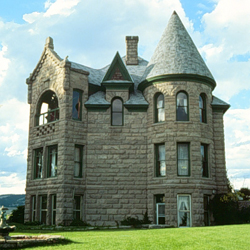
The Castle Museum is a large stone mansion that now serves as the Meagher County Museum in White Sulphur Springs, Montana. Built in the early 1890s atop a hill, it looks like a small castle and overlooks the Smith River Valley, the Castle Mountains, the Little Belt Mountains, and the Crazy Mountains. The house has twelve main rooms with hardwood floors, Belgian and Oriental rugs, Italian marble washbasins, and crystal or brass light fixtures that show how wealthy families lived during Montana's "Gilded Age." Today, exhibits inside the castle tell stories about ranching, mining, railroads, and early settlers who helped shape Meagher County.
Byron Roger Sherman's Story
The Castle was built by Byron Roger (often written Byron R.) Sherman, a businessman and rancher who played a major role in developing White Sulphur Springs. Sherman began constructing the castle-like home around 1890 on "Knob Hill," and it was completed in 1892 at a cost of about 36,000 dollars, a huge amount of money at that time. The building was made from hand-cut granite blocks hauled by oxen teams from quarries near Cottonwood Creek and from the nearby Castle Mountains, showing the strength and skill required for frontier building projects. Sherman invested in real estate, ranching, and mining and also built important town services such as big barns and early electric systems, but by 1902 he had moved to California, and the house was later sold to another family.
In 1960, Sherman's former home was donated to the Meagher County Historical Association so it could be preserved as a museum. Volunteers and local historians restored many rooms to their Victorian-era appearance using original furniture and decorations, turning the mansion into a community museum where everyone can learn about the area's past. Because the house shows both everyday objects and luxuries from the late 1800s and early 1900s, historians use it to explain how technology and wealth changed life in small Montana towns over time.
Early Electricity and Technology
The Castle was unusually modern for its time and region. Sherman installed a hot-water system powered by a windmill that pumped water up into a storage tank in the attic, where it could then flow by gravity through the house. He also added an acetylene gas plant and later electric lighting, which were rare technologies in 1890s Montana. Historical accounts describe how Sherman enlarged a spring-fed pond on his ranch and used a pipe to carry water downhill to a small electric light plant, which powered dynamos (early generators) that supplied electricity to the town for several hours each evening.
Because the water pressure dropped as the pond level fell, the early electric system could only run for a limited time each day, so townspeople planned their activities around when the lights were on. Even with these limits, White Sulphur Springs became one of the first communities in the area to have electric lights, showing how local inventors and entrepreneurs experimented with new technologies before large power companies were common. For students, the Castle's story helps explain how science and engineering ideas, like using falling water to spin turbines, were already being used in small frontier towns over 100 years ago.
Inside the Castle Today
Inside the Castle Museum, visitors walk through rooms arranged much like they would have looked in the late 1800s and early 1900s. Many rooms contain period furniture, including carved wooden pieces, upholstered chairs, beds, and tables that show Victorian-era styles. Belgian and Oriental rugs cover the hardwood floors, and Italian marble washbasins and stands can still be seen in some bathrooms, along with crystal chandeliers and brass light fixtures. Displays throughout the house feature clothing, photographs, mining equipment, household tools, and other artifacts from Meagher County's past, helping students imagine daily life for ranchers, miners, and town families.
The Meagher County Historical Association continues to care for the building and the collections, keeping the stone exterior and interior woodwork in good condition. Because the castle sits on higher ground, windows on the upper floor offer wide views in every direction, connecting the stories told inside to the real landscapes where those stories happened. The house is also listed on the National Register of Historic Places as the Byron R. Sherman House, recognizing its importance as a well-preserved example of a frontier Romanesque-style mansion.
Carriage House and Hands-on Exhibits
Behind the castle is a large carriage house museum built in the late 1980s and expanded in the 1990s to protect vehicles and other large objects that once sat in barns around the county. Inside, visitors can see buggies, wagons, sleds, and a Canyon Ferry stagecoach that once carried passengers and mail on routes east of Helena. Two horse-drawn fire engines show how towns fought fires before gasoline fire trucks and modern hydrants were available. Saddles, chaps, and other cowboy gear help tell the story of open-range ranching and how people traveled and worked before cars and paved roads.
On the upper level of the carriage house, exhibits recreate spaces like a one-room school, a bank, and a doctor's office, using real desks, medical tools, and bank teller equipment. These settings let students compare their own classrooms and towns with those from more than a century ago. Some unusual items, such as a historic "casket basket" used to transport bodies to an undertaker, remind visitors that earlier times included difficult and sometimes uncomfortable parts of life that museums must present honestly and respectfully. Together, the castle and carriage house create a "time capsule" that connects objects, architecture, and landscape to big themes like transportation, communication, and community building in Montana's history.
Visiting the Castle Museum
The Castle Museum & Carriage House is open to visitors seasonally, typically from Memorial Day weekend through Labor Day, with guided tours offered during the day. Recent information lists hours from about 10:00 a.m. to 5:00 p.m., with the last full tour starting in late afternoon, though visitors should always check for current hours before traveling. The museum offers parking, restrooms, a small gift shop with books and souvenirs, and guided tours that help explain the exhibits in age-appropriate ways.
School groups and families can walk through the castle rooms, then explore the carriage house to see vehicles, tools, and recreated spaces up close. Because the castle stands on a hill at the edge of town, a visit also gives students a chance to look out over the same valleys and mountains that early residents saw, making the connection between past and present more real. For students learning about Montana history, the Castle Museum offers a concrete example of how one person's big dreams, new technology, and changing times shaped a small community in the American West.