

Seaman
Updated: February 26, 2026
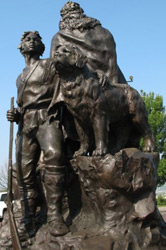
Seaman was Meriwether Lewis's large Newfoundland dog, purchased specifically for the Lewis and Clark Expedition, and he appears repeatedly in the expedition journals as a working animal and companion rather than a mascot from legend.
Purchase, breed, and work on the expedition
Lewis bought Seaman in 1803 in or near Pittsburgh while waiting for the expedition's boats, paying 20 dollars-a high price at the time and about half a month's pay for an army captain. The journals and later summaries consistently identify Seaman as a Newfoundland, a large working water dog chosen for strength, intelligence, and calm temperament. Modern estimates based on the breed and period sources suggest Seaman weighed well over 100 pounds, making him an imposing presence to people who met the Corps.
During the journey, Lewis describes Seaman catching swimming squirrels for food, hunting other small game, and accompanying hunting parties, as well as patrolling camp. In at least one entry Lewis notes that a bear raided their camp and that Seaman stayed on high alert, barking through the night, and on another occasion he credits the dog with diverting a charging buffalo bull away from the tents.
Guarding, swimming, and the beaver bite
Newfoundlands are known today as strong swimmers with water-resistant coats and webbed feet, traits that make them useful in lifesaving and water work; historical breed histories and field trials show those characteristics were already valued in the early nineteenth century. Seaman swam rivers with the Corps, retrieved animals brought down in the water, and accompanied Lewis when he scouted along shorelines, though the journals do not literally document "repeated" lifesaving rescues from drowning as later children's books and popular stories often claim.
On May 14, 1805, Lewis recorded that a wounded beaver bit Seaman's hind leg and severed an artery, and that it was very difficult to stop the bleeding. Lewis and Clark performed a crude surgical repair, and later entries confirm that Seaman recovered and continued traveling with the Corps, underscoring both his toughness and the importance of his role.
Relations with Native peoples and attempted theft
Seaman's size and appearance impressed many Native people along the route; some observers reportedly thought at first that he might be a trained bear or some other unusual animal. The journals note that dogs in general were frequently traded, eaten, or valued as goods, but Seaman himself was never traded, even though offers were made for him.
In one 1806 incident, Native people along the Columbia River region stole Seaman, prompting Lewis to send men to retrieve him. Later retellings sometimes add a threat to burn a village if he was not returned, but current summaries based on the edited journals emphasize only that Lewis acted quickly and successfully to recover Seaman, consistent with his strong attachment to the dog and his view of Seaman as part of the expedition party.
Last journal reference and the collar story
The last clear mention of Seaman in the surviving journals is Lewis's entry of July 15, 1806, where he complains that mosquitoes are so bad "my dog even howls with the torture he experiences from them." After that date Seaman is not named in any known expedition correspondence, and there is no definitive record of his fate, though historians generally assume he completed the journey and returned east with Lewis.
An 1814 book by educator Timothy Alden describes a dog collar in a museum in Alexandria, Virginia, bearing the inscription: "The greatest traveller of my species. My name is SEAMAN, the dog of captain Meriwether Lewis, whom I accompanied to the Pacifick ocean through the interior of the continent of North America." The collar itself has been lost-likely destroyed in an 1871 fire-but because Alden's account predates the widespread publication of the expedition journals and appears in a sober educational context, many historians consider it plausible evidence that Seaman survived the expedition and remained with Lewis afterward, while still noting that the story cannot be proven beyond doubt.
Place names and later memory
On his 1806 return route through what is now western Montana, Lewis labeled a small stream "Seaman's Creek" on his map, honoring his dog. Later settlers, unaware of Lewis's naming, began calling the waterway Monture Creek after George Monture, a nineteenth-century interpreter and trader, and that name became standard, though guides and educational materials sometimes still note the earlier association with Seaman.
In later centuries Seaman became a popular figure in public history, children's literature, and monument art, often depicted as a heroic rescuer and "mascot" of the Corps of Discovery. Current historical treatments try to distinguish clearly between what Lewis's journals actually document-purchase, work as a hunting and guard dog, the beaver injury, the theft, and the July 1806 mosquito entry-and the later legends that build on Seaman's story to inspire readers and visitors today.