

Plant and Animal Discoveries
Updated: March 2, 2026
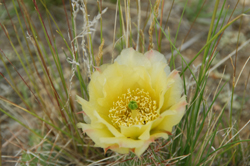
"The Corps of Discovery," the expedition led by Captain Meriwether Lewis and Lieutenant William Clark, traveled by foot, on horseback, and by canoe across the North American West from 1804 to 1806. They crossed rugged mountain ranges and endless plains, moved through dense forests and strong river currents, and navigated hazards such as cottonwood snags, rattlesnakes, grizzly bears, and dangerous rapids. They endured heat, mosquitoes, and the sharp spines of prickly-pear cactus, all while maintaining detailed scientific observations.
Lewis and Clark were unusually careful observers for their time. Meriwether Lewis had a strong interest in **botany**, developed from childhood and strengthened by his mother, who practiced herbal medicine. Before the expedition, President Thomas Jefferson arranged for Lewis to study with leading naturalists in Philadelphia, including Benjamin Smith Barton, so that he could collect and describe plants, animals, and minerals using the scientific methods of the early 1800s.
By modern scholarly consensus, the expedition documented roughly 178 plant taxa and 122 animal taxa that were then unknown to Euro-American science, even though Indigenous peoples had known and used many of them for generations. Only 237 of Lewis's plant specimens survive today because some original collections were destroyed or lost, but these remaining specimens still form part of important herbarium collections. Lewis pressed and preserved hundreds of plants and shipped or carried them, along with animal skins, skeletons, and live animals, back to the East. Among the living specimens sent to President Thomas Jefferson were a prairie dog, a sharp-tailed grouse, and several black-billed magpies.
Throughout the journey, Lewis had primary responsibility for the health of the men. He and Sacagawea paid close attention to plants that could be used as food or medicine, drawing on both written medical knowledge and Indigenous expertise along the route. Lewis's journal notes on native plants used by Native nations and the expedition-especially for food, poultices, and teas-became early written records of Indigenous ethnobotanical knowledge in the region, though they represent only a small part of that much older tradition.
Key Plants Observed by Lewis and Clark
Golden currant
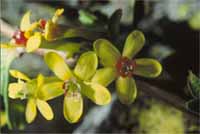
Near the Gates of the Mountains on the Missouri River in present-day Montana, Lewis and Clark noted a shrub now known as golden currant, *Ribes aureum*, which produces clusters of yellow flowers and edible berries and typically grows up to about 6-10 feet (around 2-3 meters) tall. Lewis described "yellow currant of the Missouri" and wrote that he found the yellow fruits especially pleasant, noting the abundance of red, yellow, purple, and black currants in the area. Today, golden currant is recognized as a common native shrub of riparian and open habitats in western North America and is important for wildlife and traditional food uses.
Bitterroot
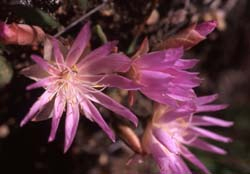
Near present-day Missoula, Lewis collected a flowering specimen of the plant now called bitterroot, *Lewisia rediviva*. Later botanists named the genus *Lewisia* in honor of Meriwether Lewis, and bitterroot is now the official state flower of Montana. Indigenous peoples, including the Salish and other Plateau groups, long used bitterroot as a staple spring food, carefully harvesting and processing the roots; Lewis's observation postdates a deep existing cultural relationship with the plant.
Wild onion and flax
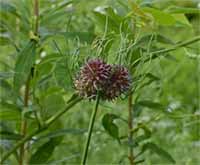
Lewis devoted substantial space in his journals to plants with potential economic value. In the Three Forks region of present-day Montana, the expedition recorded a wild onion, likely within the genus *Allium*, noting that it produced a large number of bulbs per square foot and might be a valuable food plant. In the same area, Lewis also noted a flax, later named *Linum lewisii* ("Lewis's blue flax"), and collected seeds and other plant material that he sent back to Philadelphia for cultivation and study. Today, Lewis's blue flax is recognized as a widespread native wildflower of western North America and is used in restoration and ornamental plantings.
Prickly-pear cactus
Cottonwood
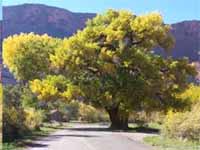
Cottonwood trees (*Populus deltoides* and related species) were among the most useful plants for the Corps of Discovery. Initially, Lewis emphasized cottonwood's value for dugout canoes and pirogues, since large trunks were available along major rivers. As the expedition continued, cottonwood also supplied fuel, building material for temporary furniture and shelters, and wood for wagons and sleds used during portages and winter encampments. Modern historians consistently note cottonwood as one of the most critical tree resources along the Missouri and Columbia River corridors for the expedition.
Birds Named for Lewis and Clark
Lewis's woodpecker
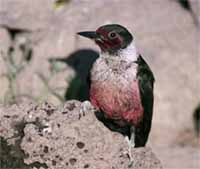
One bird was later named Lewis's woodpecker (*Melanerpes lewis*) in honor of Meriwether Lewis. He first recorded it on July 20, 1805, the day after the expedition passed through the Gates of the Mountains in what is now Lewis and Clark County, Montana. Lewis described a bird about the size of a jay, with greenish-black upperparts, a silver-gray collar and throat, and a reddish belly, remarking that the throat and belly appeared as if "artificially painted or stained." Today, Lewis's woodpecker is recognized as a distinct, insect- and flycatching woodpecker of open pine forests and burned areas in western North America, and its scientific name preserves Lewis's role in first bringing it to scientific attention.
Clark's nutcracker
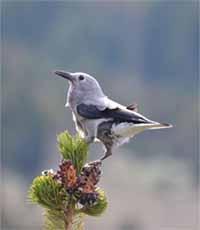
William Clark observed another distinctive bird while scouting a possible route across the Bitterroot Mountains and crossing Lemhi Pass in August 1805. He described a bird "of the woodpecker kind" that fed on pine seeds and had white tail and bill, black wings, and light brown body, about the size of a robin. This bird was later named Clark's nutcracker (*Nucifraga columbiana*) to honor Clark. Modern ornithology recognizes Clark's nutcracker as a corvid (related to jays and crows), not a woodpecker, and documents its close ecological partnership with large-seeded pines such as whitebark and limber pine, whose seeds it caches and helps disperse. The bird's current range extends year-round from British Columbia and Alberta through many of the western U.S. mountain ranges, but some regional populations may be declining as whitebark pine and related conifers are lost to disease, climate change, and altered fire regimes.
Although many geographic features now bear the names of Lewis and Clark, Lewis's woodpecker and Clark's nutcracker are the only animal species whose standard English and scientific names commemorate the two captains directly.
Large Mammals Encountered
Grizzly bear
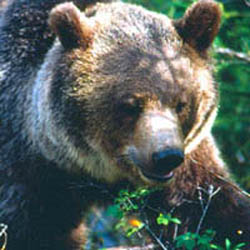
Before seeing a grizzly bear, Lewis discounted Indigenous and trapper accounts of a particularly dangerous "white" or grizzly bear, arguing that a skilled rifleman would not find the animal as formidable as people armed only with bows or poor firearms. On April 29, 1805, near what is now the Missouri River Breaks region of Montana, the Corps encountered and killed their first grizzly, an experience Lewis described in detail. Over the following months, repeated close encounters, including several near-charges and prolonged chases, convinced the captains that grizzlies were far more tenacious and difficult to kill than they had expected; some individuals reportedly required many shots, even with lung and body hits, before collapsing.
Modern historical analysis of the journals counts about 103 documented grizzly encounters, 88 of them in what is now Montana, with at least 28 bears killed and several incidents where wounded bears charged or nearly injured expedition members. Today, the grizzly bear (*Ursus arctos horribilis*) is recognized as a threatened species in the contiguous United States under federal law, with strongholds in the Greater Yellowstone and Northern Continental Divide ecosystems-regions that include many of the valleys and mountains Lewis and Clark crossed.
Bighorn sheep
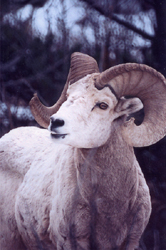
In the White Cliffs region of the Missouri River near present-day Big Sandy, Montana, the Corps frequently saw bighorn sheep on steep sandstone bluffs and rugged slopes. Lewis and Clark praised the surefootedness of these "bighorned animals," noting how they slept and moved on ledges and crevices of seemingly inaccessible cliffs where bears, wolves, and humans could not easily reach them. The animals they described are now known as Rocky Mountain bighorn sheep (*Ovis canadensis canadensis*), a subspecies that persists in parts of Montana and the West but has declined from historical numbers due to disease transmission from domestic sheep, habitat fragmentation, and hunting in the late nineteenth and early twentieth centuries.
Fish: Early Description of Cutthroat Trout

At the Great Falls of the Missouri River in June 1805, members of the Corps of Discovery ate trout that Lewis compared to familiar eastern trout but described as having deep black spots, a small red mark on each side behind the front ventral fins, and prominent teeth on the palate and tongue. These characteristics match what is now known as cutthroat trout, and historians and fisheries scientists generally agree that Lewis's Great Falls description refers to the westslope cutthroat trout subspecies, *Oncorhynchus clarkii lewisi*. The subspecies name "lewisi" honors Meriwether Lewis, and the common name "cutthroat" refers to the distinctive red or orange streak along the lower jaw and throat region, which Lewis's description anticipated.
Westslope cutthroat trout are native to parts of the upper Columbia River, the upper Missouri River headwaters, and adjacent basins on both sides of the Continental Divide, including watersheds such as the Kootenai, Clark Fork, and upper Missouri in Montana. Modern conservation assessments note that many native westslope populations have declined or become genetically mixed with non-native trout species, leading to ongoing efforts to protect remaining pure populations and restore habitat.
Scientific and Historical Perspective Today
Modern historians, biologists, and archaeologists generally agree that the Lewis and Clark Expedition was a major early scientific survey of the North American West from the perspective of the young United States, even though it built on long-standing Indigenous knowledge and existing fur-trade experience. Jefferson's detailed instructions explicitly called for the documentation of geography, geology, climate, plants, animals, and the lifeways of Native nations encountered, and the surviving journals and specimens show that the captains took this charge seriously.
Taxonomists have since revised many of the expedition's identifications and names, and some of the "new" species recorded by Lewis and Clark are now recognized as subspecies or regional forms of more widespread species. Nonetheless, the Corps' records still form a critical baseline for understanding early nineteenth-century distributions of species such as grizzly bears, bighorn sheep, and westslope cutthroat trout, and for tracking how those species' ranges and abundances have changed through time.