

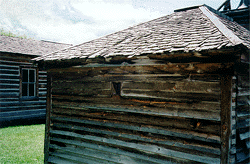
A Gold-Rush Town and a Historic Home
Virginia City began as an 1860s gold-rush boomtown but survives today as a small community that depends on ranching, county government, and tourism instead of mining.
The Sanders House is one of the best-preserved homes from those early years and helps tell the story of the Alder Gulch gold rush.
Gold Rush and Law
In 1863 prospectors discovered rich gold in Alder Gulch, leading to one of Montana's most important mining rushes.
Between about 1865 and 1875, miners in the area took out an estimated 70 million dollars in gold, and as many as 10,000 people lived in the chain of camps that included Virginia City, Nevada City, and Adobetown.
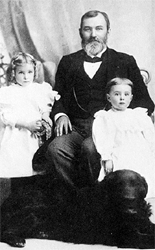
theMontana Historical Society
Photograph Archives. Material
may be protected by copyright
law, (Title 17 U.S. Code).
When the easiest gold ran out, many miners left, and Virginia City's population dropped sharply, reaching only about 149 people by 1970, though the town never completely died.
At first this region was part of Idaho Territory, with few officials to enforce the law.
Judge Sidney Edgerton and his nephew, lawyer Wilbur Fisk Sanders, traveled from Ohio in 1863, reaching Bannack in September; Edgerton later helped convince Congress to create Montana Territory in 1864 and became its first governor.
On December 21, 1863, Wilbur Sanders served as prosecutor in the miners' court trial of George Ives, accused of murder and linked to a suspected gang of "road agents."
Despite threats, Sanders won a conviction; Ives was hanged that evening after Sanders urged that the sentence be carried out at once, and the famous phrase "Men, do your duty" is traditionally credited to him.
The trial helped launch the Alder Gulch vigilantes, whose hangings of suspected criminals are still debated by historians today.
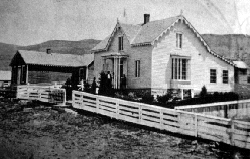
Historical Society Photograph Archives.
Material may be protected by copyright law
(Title 17 U.S. Code).
Sanders's Career and Family
Sanders went on to become a leading lawyer and politician in Montana.
He helped found the Society of Montana Pioneers, chaired the new Montana Bar Association, and served as the first president of the Montana Historical Society from 1865 to 1890.
When Montana became a state in 1889, the legislature chose him as one of its first U.S. senators after a disputed election; Congress ultimately seated Sanders and T. C. Power as Montana's senators.
Sanders died on July 7, 1905.
The Sanders family first lived in Bannack, then moved to Virginia City; Mrs. Sanders wrote in her diary on July 14, 1867, that she had just spent the first night in their new house on Idaho Street.
They lived there until the 1870s, then moved to Helena, where a larger three-story house was built in 1875.
What the House Looks Like
The Virginia City Sanders House is a one-and-a-half-story wooden cottage on a hillside lot along Idaho Street, one block above Wallace Street.
It sits on a fieldstone foundation and has steep gabled roofs of different heights, plus a hip-roofed addition on the east.
A long one-story porch stretches across almost the entire front, supported by simple wooden columns and decorated with carved brackets; a bay window with smaller brackets projects from the west side of the front room.
Old photos show that the porch was shorter at first and was later extended, and that fancy bargeboards and a carved pediment once gave the front a Gothic look before being removed around the turn of the century.
Shutters were added to the front windows, and later changes included a larger picture window on the west, kitchen remodeling, and a small enclosed rear entry.
Many original details survive, including 4-over-4 wood sash windows, paneled doors with ornate trim, and decorative cast-metal hinges, knobs, and latches.
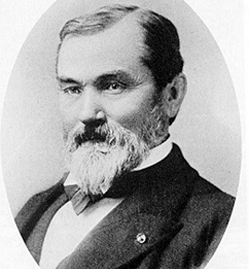
Society Photograph Archives. Material may
be protected by copyright law
(Title 17 U.S. Code).
Ownership and Importance
The house has had few owners: by 1899 it belonged to A. W. Hall, later to Jones Duncan, and in 1940 to James Vanderbeck, who cared for the property and kept it in good condition.
Today the Sanders House is recognized on markers as one of Montana's oldest continuously occupied frame homes and as the residence of a key figure in the territory's early legal and political history.
For students, it offers a concrete link to the gold-rush era and shows how a modest family home can survive long after the boomtown around it has changed.
Credits
Special acknowledgements go to historians and archivists whose research and documentation help us understand the life of Wilbur Fisk Sanders and the history of his Virginia City home.